Wednesday, February 12, 2014

Internal Medicine Board Review Pearls now Available on iTunes, Google Play, Kindle, and Nook

Knowmedge is excited to announce its second eBook, High-Yield Internal Medicine Board Review Pearls, is now available for download on iOS, android and kindle devices. This eBook contains 17 chapters of Internal Medicine board review pearls. The chapters within the book are based on the Internal Medicine ABIM exam blueprint and cover a wide range of topics including Cardiology, Endocrinology, Neurology, Hematology, Infectious Disease, Oncology, and Gastroenterology. The book also contains two bonus chapters focused on strategies and resources used to study for both the Internal Medicine Shelf Exam and ABIM Board Exam.

The Internal Medicine High-Yield Internal Medicine Board Review Pearls eBook contains many images and slides in the format seen within the Knowmedge internal medicine question bank. The colorful images are designed to be quick reviews of complex material likely to be tested on any Internal Medicine board exam. In addition to those taking the ABIM and In-Training Exams, the book can be a helpful tool for those studying for the Internal Medicine Shelf Exam, In-Training exam, or USMLE Step 3 exam.

The Knowmedge High-Yield Internal Medicine Board Review Pearls can be downloaded immediately from iTunes, Google Play, Amazon.com, and BarnesandNoble.com. For more information regarding the Knowmedge internal medicine question bank and board review eBooks, please visit http://www.knowmedge.com


Google-Play-Internal-Medicine-Board-Review
Kindle-Internal-Medicine-Board-ReviewiTunes Internal Medicine Review


Nook Internal Medicine Board Review

Knowmedge and Docphin announce collaborative agreement for Internal Medicine Board Review Questions

Docphin, an evidence-based medicine content management platform for hospitals and healthcare providers, to feature content from the Knowmedge Internal Medicine Question Bank on its web and mobile platforms


Feb. 11, 2014 - COLUMBUS, Ohio  Knowmedge, an internal medicine board review question bank provider, and Docphin, an evidence-based content management platform for hospitals and healthcare providers, are excited to announce a collaborative agreement for ABIM exam content. Under this agreement, Docphin will feature Knowmedge’s ABIM Board Exam practice questions on its web and mobile platform for medical residents and physicians to test their internal medicine knowledge. The agreement also lays the groundwork for further collaboration and opportunities to enhance medical education. Dr. Ravi Bhatia, co-Founder of Knowmedge, states “Docphin is a valuable data aggregation platform for residents and physicians. Their web and mobile platforms are an excellent resource for physicians to stay on top of all the relevant news in medicine. We are excited about the opportunity to work with the Docphin team to provide Internal Medicine questions and content to enhance medical education.”

Dr. Mitesh Patel, CEO of Docphin, states “Incorporating Knowmedge’s high yield ABIM Internal Medicine Board Exam style questions on to the Docphin platform will provide us an additional resource to further improve medical education. Docphin and Knowmedge share a similar vision to improve medical education and this collaboration sets the groundwork for our companies to continue working together to help residents and physicians build their medical knowledge.”

Docphin’s (www.docphin.com) provider platform streamlines access to medical research from over 5000 journals and recommends content that’s relevant to your interests and trending among your peers. Docphin’s hospital platform enables departments and residency programs to upload clinical guidelines, hospital protocols, and decision-making references for mobile access and provides detailed engagement metrics to help accelerate the implementation process within the healthcare system. Docphin is used at over 350 institutions in more than 15 countries by all types of providers and students including physicians, nurses, pharmacists, engineers, and scientists. Docphin is available for iPhone, iPad, Android, and Web.

Knowmedge (www.knowmedge.com) is a medical exam prep provider focused on Internal Medicine board review questions. The Knowmedge Internal Medicine question bank contains over 900 board review questions. The question bank has been used by physicians and residents at over 100 institutions. The question bank is used by physicians preparing for the numerous exams, including ABIM Board exam, In-training Exam, Internal Medicine Shelf exam, and the USMLE Step 3 exam.

Monday, February 3, 2014

ABIM Maintenance of Certification (MOC) Requirements Changes

The American Board of Internal Medicine (ABIM) has implemented changes to the Maintenance of Certification (MOC) requirements. Like the 24 other specialty boards, ABIM will have a 4 Part Process:
  • Part I: Professional standing (licensure)
  • Part II: Lifelong learning and self-assessment
  • Part III: Cognitive expertise (examination)
  • Part IV: Practice performance assessment (performance improvement project)

Parts I and III are essentially unchanged. However Parts II and IV are new additions. Part II is the lifelong learning and self-assessment component. It includes continuing medical education (CME) and online modules for most boards.

Starting in 2014, the ABIM now maintains a report indicating if ABIM Board Certified physicians are “meeting MOC requirements”.

The ABIM has detailed the changes in the MOC requirements. It’s a bit of a maze to try and follow all the details so we’ll give you the high level bullets here.

What has changed?
Previous: You were required to maintain your Internal Medicine Board Certification by “simply” passing the ABIM Board Exam every 10 years.

ABIM MOC Changes: In order to be “meeting MOC requirements”, you will still need to pass the ABIM Board Exam every ten years. In addition, you will need to:
  • Complete at least one ABIM-approved MOC activity every two years
  • Earn at least 100 ABIM MOC points every five years with:
    • At least 20 points in medical knowledge
    • At least 20 points in practice assessment
  • Fill out a patient safety and a patient experience survey requirement every five years

Why the changes?
We are certainly no experts in this area. The ABIM argues that “There is growing recognition and agreement from the public, consumer groups and medical organizations that assessing knowledge and performance every 10 years is not sufficient.” Others could certainly argue this is all about money and power (after all, ABIM isn’t implementing these changes without a financial benefit).

There are certainly those that think the MOC changes are helpful and for the better. Then there are those that take a more cynical, yet  popular – and perhaps accurate – view of the changes. Regardless, these are the rules, at least for now, that you have to play by if you want to maintain your Internal Medicine Board Certification.

What’s the cost of this?
Fees (currently) for the Internal Medicine MOC are $194 annually or $1,940 on a 10-year basis. You can choose to pay annually or pre-pay for 10 years. If you maintain certification for other specialties, the fees are different.

What if I just got certified? What if I need to certify in 2014? What about 2015? What if I’ve been “Grandfathered” in?
Almost universally, regardless of when you need to certify, you will be impacted by the changes. Even for those grandfathered in and not having to meet any requirements previously, you will now be listed as “not meeting MOC requirements” (If you are grandfathered in, you will still maintain your certification but you will be listed as “not meeting requirements”)

In order to understand your specific situation, you should review the MOC requirements website where it details the actions you will need to take depending on when you need to recertify.

Does the ABIM know my contact information?
Make sure you update it if you have not provided them with the most current information. You can update your contact information online.

What medical knowledge modules / products can I complete to earn points?
You can earn medical knowledge points through the ABIM directly or from other professional organizations. A list of ABIM’s medical knowledge modules can be found on their website.

You can see a list of medical knowledge modules products developed by professional organizations at the ABIM website.

How can I earn practice assessment points?
You can earn practice assessment points by completing ABIM PIMs Practice Improvement modules or through the Approved Quality Improvement (AQI) pathway.

What if I need help?
With all the rules and requirements that are needed to make this transition, it can get confusing. If you do need help, you can contact the ABIM at 1-800-441-ABIM or email them at MOC2014@abim.org

The bottom line
The ABIM Maintenance of Certification requirements have changed. To maintain Board Certification, you have to play by their rules. It can be confusing and it will cause problems, especially in the first few years of this transition, but the change is here to stay.

To learn more about the ABIM Maintenance of Certification (MOC) requirements, visit the ABIM MOC website.

Internal Medicine Board Review Courses

Internal Medicine Board Review Courses


Are you studying for the ABIM Internal Medicine Board Exam? We’ve touched upon our suggestions for studying for the ABIM exam including a brief overview of the independent internal medicine board review courses.

There are a lot of internal medicine board review course options. We’ll cover the ones we’re aware of here. If you know of one we’ve missed, please post a comment or send us a note at support@knowmedge.com.

Independent Internal Medicine Board Review Courses


iMedicine Review

Internal Medicine Board Review Course - iMedicine Review - Shahid Babar
iMedicine Review – Shahid Babar

Website: www.imedicinereview.com

Taught by: Shahid Babar, MD FACP FHM

Overview: Dr. Babar has been conducting Internal medicine board review courses at various academic centers since 2007. He founded iMedicine Review in 2010 and in addition to continuing his live courses, he created educational apps for residents and physicians preparing for ABIM Internal medicine board exam. His courses are 3 ½ days long and take place in various cities around the country.


Locations / Dates: Dr. Shahid Babar’s will be teaching his iMedicine Review course at five different locations in 2014.
    University of Pennsylvania, Perelman Quadrangle
    Philadelphia, PA
    May 15, 16, 17 & 18, 2014 (Thursday – Sunday)

    PinnacleHealth Hospital Program Harrisburg, PA
    May 29, 30, 31 & June 1, 2014 (Thursday – Sunday)

    University of Connecticut
    Farmington, CT
    June 12, 13, 14 & 15, 2014 (Thursday – Sunday)

    AMA Executive Conference Center
    New York, NY
    July 9, 10, 11 & 12, 2014 (Thursday – Sunday)

    The George Washington University
    Washington, DC
    July 24, 25, 26 & 27, 2014 (Thursday – Sunday)
Cost
The cost of the iMedicine Review course varies depending on a few factors:
  • Physicians – $695.00
  • Residents – $595.00
  • Groups of 2 or more – $545.00
  • Chief Residents – $245.00
Contact
You can contact iMedicine Review through the website or directly by emailing info@imedicinereview.com.

Note: Dr. Shahid Babar is an advisor to Knowmedge .

Awesome Review

Internal Medicine Board Review Course - Awesome Review - Habeeb Rahman
Awesome Review – Habeeb Rahman

Website: www.tutormd.com

Taught by: Habeeb Rahman, MD

Overview: This Internal Medicine Board Review course taught by Dr. Habeeb Rahman is a popular option for residents. While more expensive than some of the other review courses, the high-yield animations and notes presented by Dr. Rahman make this a worthwhile experience for many who take his Awesome Review course.

Locations / Dates: Dr. Habeeb Rahman will be teaching his Awesome Review course at ten different locations in 2014.
    Maimonides Medical Center
    Brooklyn, NY
    January 22 – March 13 (Weekday nights)

    Roosevelt Hospital
    New York, NY
    January 21 – February 27 (Weekday nights)

    North Shore University Hospital
    Manhasset, NY
    February 8 – February 23 (Saturday and Sunday)

    Newark Beth Israel Medical Center
    Newark, NJ
    March 1 – March 16 (Weekends)

    Advocate Christ Medical Center
    Oaklawn, Illinois
    March 21 – March 30 (Friday, Saturday, Sunday)

    New York Hospital of Queens
    Flushing, NY
    April 5 – April 20 (Saturday, Sunday)

    Crowne Plaza Phoenix Airport Hotel
    Phoenix, AZ
    April 25 – May 4 (Friday, Saturday, Sunday)

    Hilton Hotel
    East Rutherford, NJ
    June 1 – June 6 (Sunday – Friday)

    Holiday Inn Hotel
    Long Beach, CA
    June 13 – June 22 (Friday, Saturday, Sunday)

    Empire Meadowlands Hotel
    Secaucus, NJ
    July 14 – July 19 (Monday – Saturday)
Cost
The cost of the Aweome Review course varies depending on the size of the group:
  • Group of less than 10 people: $1,045.00
  • 10 or more people: $995.00
Contact
You can contact Awesome Review through the website or directly by emailing info@awesomereview.com or by calling 201-905-0102 or 201-888-1002.

Unique Review Course

Internal Medicine Board Review Course - Unique Course - Satish Dhalla
Unique Course – Satish Dhalla

Website: www.uniquecourse.com

Taught by: Satish Dhalla, MD FACP

Overview: Of the three Internal Medicine Board Review independent courses, this is the oldest. Dr. Dhalla has been director of the Unique Course Board Review since 1995.

Locations / Dates: Dr. Satish Dhalla will be teaching his Unique Course twice in 2014.
    Double Tree Hilton
    Fort Lee, NJ
    June 23 – June 28 (Monday – Saturday)

    Double Tree Hilton Fort Lee, NJ
    July 14 – July 19 (Monday – Saturday)
Cost
The cost of the Unique Course is $1,095.00.

Other Internal Medicine Board Review Courses
There are a lot of other Internal Medicine Board Review courses. We’ll go through the ones we’re aware of here:

Mayo Clinic Internal Medicine Board Review
Cleveland Clinic Internal Medicine Board Review
American College of Physicians (ACP)
Columbia University Internal Medicine Board Review
GoFrontRunners
MedStudy Internal Medicine Board Review
American Physician Institute for Advanced Professional Studies (The Pass Machine)
  • Website: Internal Medicine Review Course
  • Dates: March 21 – March 23 / June 13 – June 15 / August 15 – August 17
  • Locations: Chicago, IL
  • Cost: $1,297
If you know any internal medicine board review courses we have missed, please let us know.

If you have used an internal medicine live course to study, please share your feedback with us in the comments section. We all benefit from learning about the various internal medicine board review courses that are offered. 

Sunday, January 26, 2014

MKSAP 16 Review

You may have already come across Knowmedge’s coverage of several other ABIM Internal Medicine Board Review books. Today, we explore the “big daddy of them all”—the Medical Knowledge Self-Assessment Program (MKSAP), created by the venerable American College of Physicians (ACP). Ask any Internal Medicine resident—1st, 2nd, or 3rd year—how they plan on studying for the Internal Medicine board exam, and their response will surely include “MKSAP.” Furthermore, residency chiefs have developed a tendency of using MKSAP questions for board review at morning report, noon conference or even afternoon educational sessions. There is a reason for its vast utility: MKSAP is truly an authoritative guide to reviewing the curriculum covered in the ABIM Internal Medicine Board Review Blueprint.

In its 16th iteration, the MKSAP content has been refreshed as well as the user interface on the app/desktop versions creating a better learning experience.

Let’s begin with the many plusses of MKSAP 16:
  • First and foremost, with dozens of contributors in each of the major internal medicine sub-specialties, the medical content in the text and 1,200 questions is well-researched with bibliographic citations.
  • Lots of tables and figures help break up the text which can otherwise be cumbersome to stay engaged while reading. Later in your studying, revisiting these tables is a good approach.
  • One of my favorite features is the High-Value Care Recommendations that opens each book. Here’s why: the folks behind the ABIM, like the healthcare policy makers, are concerned about the overuse/inappropriate use of tests in the diagnostic work-up of commonly encountered symptoms. Thus, these points which emphasize unnecessary tests/treatments may be commonly tested on the actual exam. Furthermore, I’ve referred back to this section during patient care to determine if a test is actually necessary or extraneous before initiating treatment.
  • Dermatology contains vivid photos of the skin lesions commonly encountered on the exam. However, it would be nice if they had had a separate section with just images so you can quiz yourself near the end of your exam preparation.
  • Same goes for EKGs on the cardiology section and chest xrays on the pulmonary sections.
  • A Key Points highlighted box contains high-yield nuggets that help summarize major topics
  • Each subject area is a separate book (in the print version) or a separate heading in the digital version making it very easy to handle physically. I recall using MKSAP 15 on my specialty rotations. I’d carry the appropriate book around but they wouldn’t unfortunately fit in my white coat pocket. The MKSAP online version solves this problem as many residents have found.
  Now for some areas that could be improved in MKSAP 16:
  • While the figures and photos do break up the monotony of the text portions, the question explanations are still too long. I can understand the need to have lengthy text in the syllabus (MKSAP 16 is a powerful clinical tool and a nice reference to have when reviewing a patient’s diagnosis), for questions, it’s not high-yield and efficient to have to read 4 or 5 paragraphs after each question. In fact, this was the reason Knowmedge was created. We felt that in the 21st century, the Internet allows better methods to facilitate knowledge retention such as audio-visual explanations.
  • An H icon highlights topics that address “the learning needs of the increasing number of physicians who work in the hospital setting.” Since this feature is mentioned in the letter from Dr. Patrick Alguire (Editor-in-Chief ) at the beginning of each book, I initially thought it was beneficial. But then it occurred to me that for someone not studying for the Hospital Medicine Maintenance of Certification,  it’s not entirely clear what to do with the icon. Surely, I don’t just skip over the blue text sections like porphyria cutanea tarda diagnosis and constipation management, which are just as likely to be on either exam. Instead, it ended up just being a distraction.
  • A final minor point (literally): the index on the print version of MKSAP is in the smallest type I have ever come across. It must be 8 point or less. I don’t have any near vision problems and I felt tempted to reach for a magnifying glass.
  • MKSAP Online: The digital version is much improved from the previous iterations such as MKSAP 15. While it now allows better analytics of your question responses, its interface is not as user friendly as one would hope. For instance, unlike most websites/ apps the menu toolbar appears on the upper right side of the screen rather than the left side. On the app, overlays should have been utilized for Normal Lab Values and Bibliography and Key Points rather than forcing the user to leave the current topic.
While there are areas of improvement that could be made, overall, the MKSAP 16 Books are a valuable and authoritative source for Internal Medicine Board Review.

Wednesday, January 15, 2014

Internal Medicine Board Review: Oncology

Oncology is an essential part of the Internal Medicine Medical Clerkship and ABIM Board exam. According to the ABIM exam blueprint, questions testing Oncology topics comprise ~7% of the exam. Initially, oncology seems like a very difficult subject given how the treatment regimens of the many types of carcinomas are ever-changing. However, realize that Internal Medicine exams are focused on the basics of the different malignancies. These 8 pearls will get you off to a good start for identifying
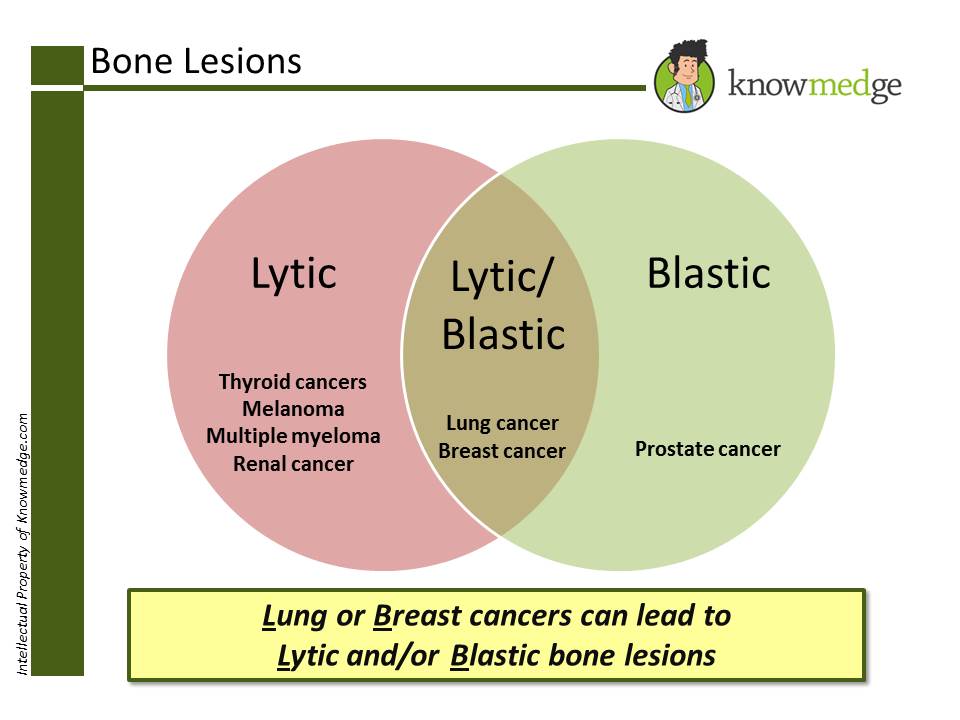
1. Which cancers correspond to lytic bone lesions? Blastic? Lytic or Blastic?
    • Lytic bone lesions
      • Melanoma
      • Multiple Myeloma
      • Renal cell cancer
      • Thyroid cancer
    • Blastic bone lesions
      • Prostate cancer
    • Lytic or blastic lesion
      • Lung cancer
      • Breast cancer
Bone Lesions
Click on image to enlarge
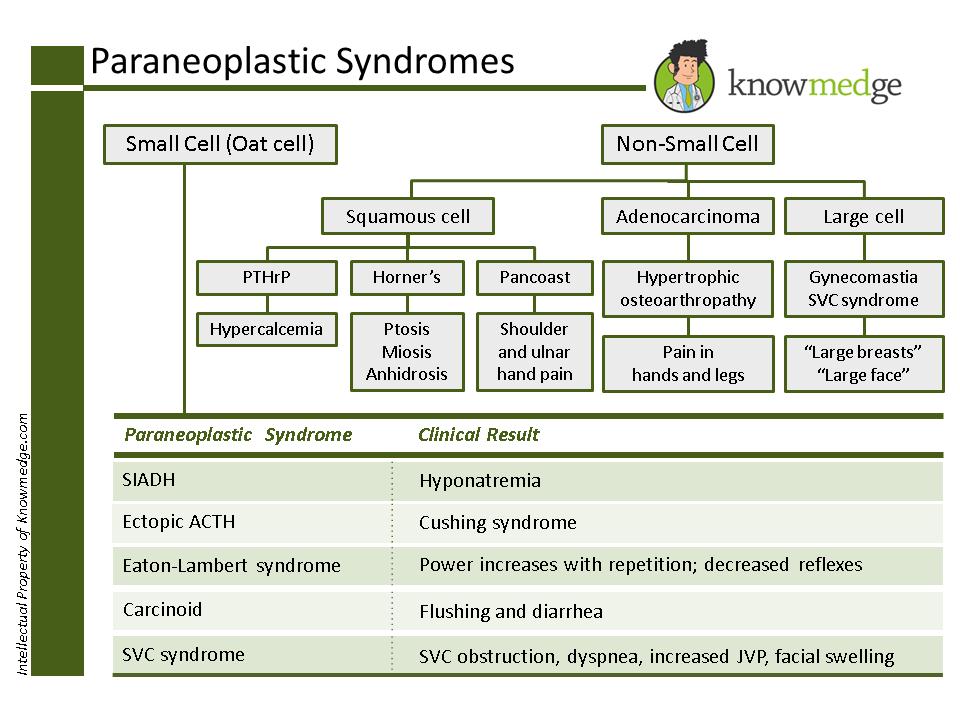
 2. Which paraneoplastic syndrome goes with which cancer?USMLE Step 1 Exam Practice Question - Paraneoplastic Syndromes
Click on image to enlarge
 3. Know these high-yield Breast Cancer facts for the ABIM and IM shelf exams
  • If the lesion is >1cm OR the patient has lymph node involvement → chemotherapy will be part of the treatment protocol.
  • If sentinel node biopsy is negative → no further lymph node biopsy is required
  • If the patient’s breast cancer is ER/PR (+) and patient is pre-menopausal →Tamoxifen is given X 5 years
  • If the patient’s breast cancer is ER/PR (+) and is post-menopausal → Aromatase inhibitors (eg. Anastrozole) is given
  • If the patient’s breast cancer is HER2/neu (+)→ Trastuzumab is given →can cause CHF →check echocardiogram to assess left ventricular function
  • Triple negative breast cancer (ER negative, PR negative, HER2/neu negative) have the worst prognosis
4. Don’t let chromosomal translocations overwhelm you
  • t (14,18) → Follicular Lymphoma
  • t (8,14) → Burkitt’s Lymphoma
  • t (9,22) → Known as Philadelphia Chromosome (BCR-ABL) gene fusion → good prognosis in CML patients and bad prognosis in ALL patients
  • t (15,17) → Acute promyelogenous Leukemia (M3) → good prognosis → Treatment is with All-Trans Retinoic Acid (ATRA)
  • t (11,14) →Mantle cell Lymphoma → highly aggressive form of Non-Hodgkin’s Lymphoma → cyclin D1 oncogene is overexpressed → treat with R-CHOP
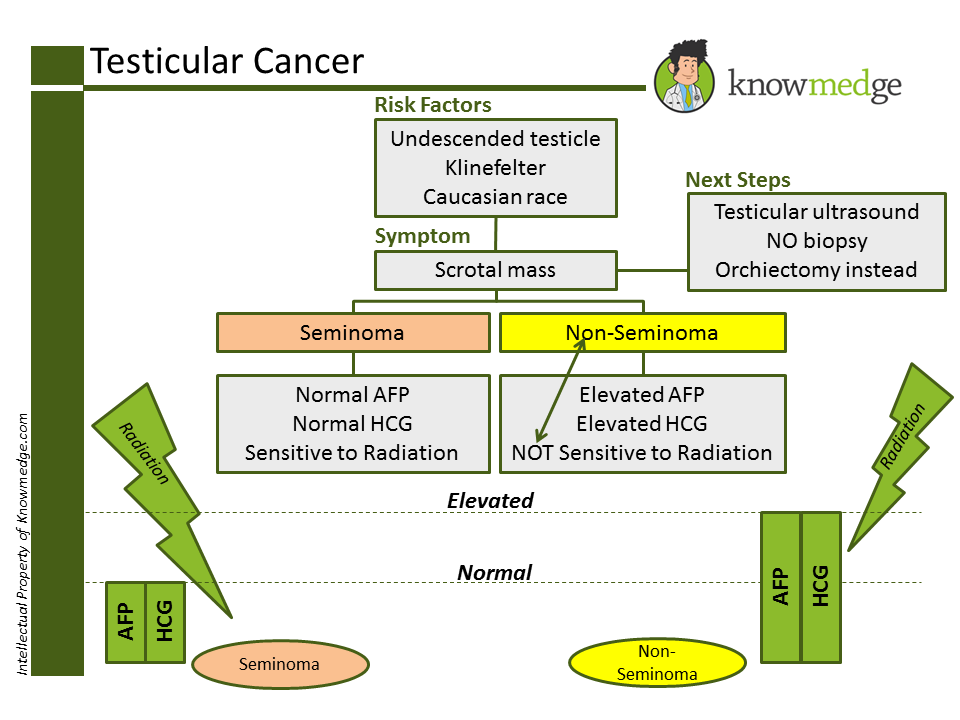
5. Testicular cancer is broken down into seminomas and non-seminomas
  • Seminomas are Radiation sensitive and usually have a normal AFP and HCG level
  • Non-Seminomas (eg, yolk sac tumor, embryonal carcinoma, teratoma, choriocarcinoma) are radiation resistant and usually have elevated AFP and HCG level
  ABIM Board Exam Maintenance of Certification Review - Testicular Cancer
 Click on image to enlarge
6. High-yield facts about Colon Cancer for the ABIM and IM Shelf Exam
  • If cancer invades mucosa or sub-mucosa → colon resection is required
  • If cancer invades muscularis propria, serosa, or has LN involvement →colon resection is required +chemotherapy (usually FOLFOX) +/- Irinotecan. FOLFOX is 5 flurouracil, Oxaliplatin, and Leucovorin
  • Most common area of metastasis for colon cancer is the liver
  • If solitary liver lesion →resection of liver can be performed
  • If multiple liver lesions → poor prognosis and survival rate is low
7. Must know Oncological Emergencies a.) Superior Vena Cava Syndrome → caused by obstruction to the superior vena cava leading to:
  • Neck and facial swelling
  • Dyspnea
  • Cough
  • Physical examination will show distended jugular veins
  • Chest x-ray may reveal mediastinal widening or right hilar mas
  • Most common cause is lung cancer (particularly small cell lung cancer). Malignant lymphoma is also a well-known cause of superior vena cava syndrome
  • Management obviously requires treatment of the underlying malignancy but symptomatic measures such as diuretics and elevation of the bed usually suffice
b.) Spinal cord compression
  • Most common cancers that cause spinal cord compression are: Lung cancer, breast cancer, prostate cancer, multiple myeloma, and lymphoma
  • Back pain is the most commonly presenting symptom. Other concerning symptoms include muscle weakness, numbness/tingling, cauda equina syndrome, and loss of bowel or bladder control
  • Diagnosis is required promptly to prevent further neurological deterioration and an MRI OF THE ENTIRE SPINE IS REQUIRED FOR DIAGNOSIS
  • Management for spinal cord compression is with Dexamethasone 10 mg IV X 1 dose, followed by Dexamethasone 4 mg IV every 6 hours.
  • Radiation therapy can help in shrinking the tumor; however, recent studies indicate that surgical decompression is superior to RT. Therefore, an immediate neurosurgical consultation is required when this condition is suspected or diagnosed.
c.) Tumor lysis Syndrome
  • Intracellular contents leak out into the bloodstream.
  • Although this condition can occur with any malignancy, it is more common in aggressive lymphomas and hematological malignancies.
  • Hyperkalemia, Hyperuricemia, Hyperphosphatemia, Acute renal failure, and hypocalcemia are often seen in patients with tumor lysis syndrome
  • Management of tumor lysis syndrome requires electrolyte abnormality correction, aggressive hydration, and allopurinol
Once again, the folks who write the Internal Medicine licensing exams don’t expect you to have the depth of knowledge regarding the plethora of cancer diagnoses that an oncologist possesses. However, topics such as the ones mentioned in the pearls above should assist you with the oncology section of the med school clerkship shelf and ABIM board exams.

Medical Mnemonics: Normal Pressure Hydrocephalus


Medical Mnemonic: “Wacky, Wobbly, Wet”

Patients who present with the triad of urinary incontinence, wide-based gait and dementia are likely to have normal pressure hydrocephalus (NPH). Symptoms for these patients are often remembered by the mnemonic “wacky, wobbly, and wet.”
  • Wacky: Dementia and mental impairment
  • Wobbly: Wide based gait (Difficulty walking)
  • Wet: Urinary Incontinence

NPH is a condition where excess cerebrospinal fluid (CSF) has slowly built up in the ventricles. Patients with NPH are generally older (over the age of 60). CT or MRI of the brain would reveal dilated ventricles without dilatation of sulci.

This is the first in our series of Medical Mnemonics Monday posts. You can all previous and future medical mnemonics here.