The postpartum period can be a chaotic time for many women. Right after birth, women experience an abrupt decline in their estrogen and progesterone levels which are known to help regulate mood states. As a result, many new mothers are susceptible to drastic mood changes during this period. Their risk for postpartum psychiatric issues can dramatically increase when dealing with stressful life events, interpersonal problems, an infant with health issues, a prior history of depression, family history of depression, an unplanned pregnancy, and/or poor social support.
Sunday, March 30, 2014
“Baby Blues”: What Every Internist Should Know About Postpartum Psychiatric Dx

Internal Medicine Board Review: Ring-Enhancing and Non-Enhancing Lesions
A favorite of the USMLE Steps, NBME Internal Medicine Shelf, and ABIM Internal Medicine Board Exams seems to be those ring-shaped lesions picked up on imaging studies. Often, the scenario is a ring lesion identified on a CT head scan in an immunocompromised patient (particularly one with HIV or AIDS). These can be challenging because the clinical vignette focuses on the description of the lesion without providing detailed serologies. So let’s use an efficient approach to identifying the most commonly encountered ring lesion etiologies on medical exams.
The first step is to determine whether the lesion presented on the CT scan is ring-enhancing or non-enhancing.
If it is a ring-enhancing lesion, the most commonly seen etiologies are
- Cerebral toxoplasmosis (50%)
- Primary central nervous system (CNS) lymphoma (30%)
- Less commonly, Bacterial or Fungal abscess (e.g. Cryptococcosis, Histoplasmosis, Aspergillosis, Tuberculosis and Trypanosomiasis)
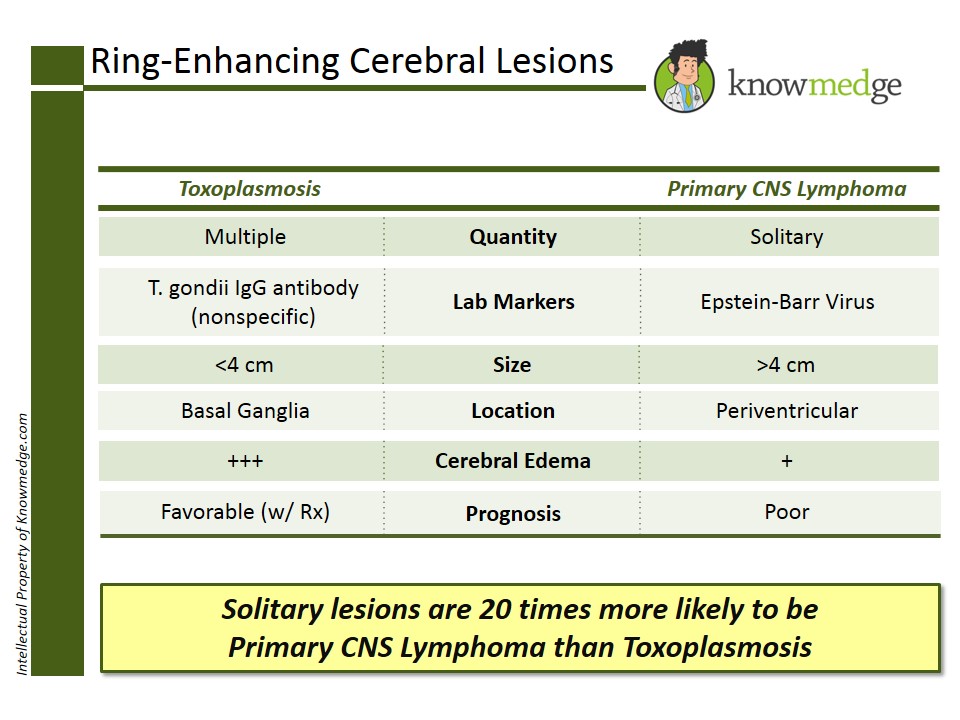
Cerebral Toxoplasmosis is the most common cause of ring-enhancing cerebral lesions. Often, multiple lesions are seen, usually located in the basal ganglia. It is unlikely to be seen in a patient who is already receiving prophylactic trimethoprim-sulfamethoxazole (TMP-SMX). Patients with AIDS and CD4 count less than 100/microL are at increased risk. It’s very important to remember that Toxoplasmosis serologies are non-specific but patients with cerebral toxoplasmosis are seropositive for T. gondii IgG antibody.
Primary CNS Lymphoma is the second most common cause of a ring-enhancing cerebral lesion. Unlike cerebral toxoplasmosis, primary CNS lymphoma may be solitary. Thus, if a solitary lesion is detected, even if toxoplasma serology is positive, CNS lymphoma is the more likely diagnosis than toxoplasmosis. The location of CNS lymphoma is more commonly in the periventricular areas. Lesions greater than 4cm in diameter are more likely to be primary CNS lymphoma rather than cerebral toxoplasmosis. Epstein-Barr virus (EBV) DNA in the cerebrospinal fluid (CSF) is quite specific for primary CNS lymphoma.
And the ring non-enhancing lesions are typically due to…
Progressive Multifocal Leukoencephalopathy (PML), which is attributed to the JC virus. It presents with multiple demyelinating lesions. It predominantly affects the white cerebral matter, in particular the brainstem and the cerebellum. Other patients at risk of developing PML are those receiving natalizumab therapy for relapsing-remitting multiple sclerosis, efalizumab for psoriasis, and brentuximab for Hogkin’s lymphoma.
I hope you find this review helpful in rapidly identifying the cause of each brain-ring lesion you may encounter on the USMLE Steps, NBME Internal Medicine Shelf, and ABIM Internal Medicine Board Exams.
Thursday, March 27, 2014
Internal Medicine Board Review: Ring-Enhancing and Non-Enhancing Lesions
A favorite of the USMLE Steps, NBME Internal Medicine Shelf, and ABIM Internal Medicine Board Exams seems to be those ring-shaped lesions picked up on imaging studies. Often, the scenario is a ring lesion identified on a CT head scan in an immunocompromised patient (particularly one with HIV or AIDS). These can be challenging because the clinical vignette focuses on the description of the lesion without providing detailed serologies. So let’s use an efficient approach to identifying the most commonly encountered ring lesion etiologies on medical exams.
The first step is to determine whether the lesion presented on the CT scan is ring-enhancing or non-enhancing.
If it is a ring-enhancing lesion, the most commonly seen etiologies are
- Cerebral toxoplasmosis (50%)
- Primary central nervous system (CNS) lymphoma (30%)
- Less commonly, Bacterial or Fungal abscess (e.g. Cryptococcosis, Histoplasmosis, Aspergillosis, Tuberculosis and Trypanosomiasis)
Cerebral Toxoplasmosis is the most common cause of ring-enhancing cerebral lesions. Often, multiple lesions are seen, usually located in the basal ganglia. It is unlikely to be seen in a patient who is already receiving prophylactic trimethoprim-sulfamethoxazole (TMP-SMX). Patients with AIDS and CD4 count less than 100/microL are at increased risk. It’s very important to remember that Toxoplasmosis serologies are non-specific but patients with cerebral toxoplasmosis are seropositive for T. gondii IgG antibody.
Primary CNS Lymphoma is the second most common cause of a ring-enhancing cerebral lesion. Unlike cerebral toxoplasmosis, primary CNS lymphoma may be solitary. Thus, if a solitary lesion is detected, even if toxoplasma serology is positive, CNS lymphoma is the more likely diagnosis than toxoplasmosis. The location of CNS lymphoma is more commonly in the periventricular areas. Lesions greater than 4cm in diameter are more likely to be primary CNS lymphoma rather than cerebral toxoplasmosis. Epstein-Barr virus (EBV) DNA in the cerebrospinal fluid (CSF) is quite specific for primary CNS lymphoma.
And the ring non-enhancing lesions are typically due to…
Progressive Multifocal Leukoencephalopathy (PML), which is attributed to the JC virus. It presents with multiple demyelinating lesions. It predominantly affects the white cerebral matter, in particular the brainstem and the cerebellum. Other patients at risk of developing PML are those receiving natalizumab therapy for relapsing-remitting multiple sclerosis, efalizumab for psoriasis, and brentuximab for Hogkin’s lymphoma.
I hope you find this review helpful in rapidly identifying the cause of each brain-ring lesion you may encounter on the USMLE Steps, NBME Internal Medicine Shelf, and ABIM Internal Medicine Board Exams.
Tuesday, February 25, 2014
Medical Mnemonics: Felty Syndrome Components
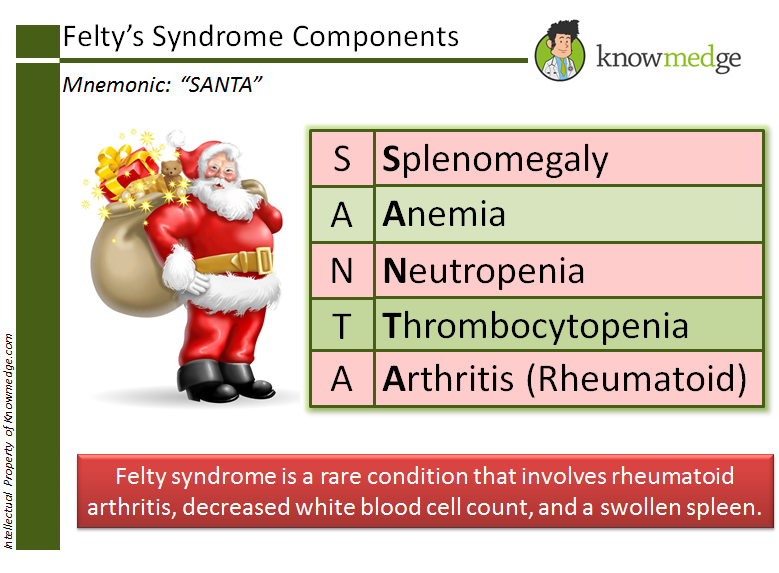
Medical Mnemonics: Felty Syndrome
- S – Splenomegaly
- A – Anemia
- N – Neutropenia
- T – Thrombocytopenia
- A – Arthritis (Rheumatoid)
Thursday, February 13, 2014
Book Review: The John Hopkins Internal Medicine Board Review
The John Hopkins Internal Medicine Board Review
- Pre-Read: Maximizing Test Performance: Effective Study and Test-Taking Strategies (3 pages)
- Section I: Cardiology (64 pages)
- Section II: Infectious Disease (58 pages)
- Section III: Pulmonary and Critical Care Medicine (56 pages)
- Section IV: Gastroenterology (45 pages)
- Section V: Nephrology (33 pages)
- Section VI: Endocrinology (40 pages)
- Section VII: Rheumatology (33 pages)
- Section VIII: Hematology (38 pages)
- Section IX: Oncology (39 pages)
- Section X: Neurology (24 pages)
- Section XI: Selected Topics in General and Internal Medicine (106 pages)
- List price: $94.12
- Current Amazon price: $94.12
- eBook (Kindle): $56.97
To see other internal medicine board review books, head over to the Knowmedge Internal Medicine Question Bank Blog.
Book Review: Mayo Clinic Internal Medicine Board Review
Mayo Clinic Internal Medicine Board Review
The Mayo Clinic Internal Medicine Board Review, 10th edition book, published by Oxford University Press, was developed as a comprehensive review guide specifically for those preparing for the ABIM Internal Medicine Board Exam. Edited by Dr. Amit Ghosh, this approximately 800 page book is used by residents and internists, both as a reference tool and a book for internal medicine board review.
Publication Date: June 27, 2013
Editor: Robert Ficalora MD
Breakdown of Book (Chapters):
Amazon average reviews (as of 12/16/2013): N/A
Amazon Best Sellers Rank (as of 12/16/2013): #70,188
Our opinion as a book for Internal Medicine Board Exam Review:
The Mayo Clinic Internal Medicine Board Review is a great resource for Medical Students, Residents, and Internists. The information is up-to-date and the editor has done a great job bringing all the pieces together. The book is well-written, thorough and comprehensive for board review. The authors have done an excellent job of ensuring the information is properly cited throughout the book. The use of images and tables in this book is also fantastic! The book is extremely high-yield and we could certainly see someone highlighting much of the book.
After complaints of the size of the previous edition book (~1,000 pages), this book has been redesigned, updated and condensed slightly 801 pages. The biggest reason for the reduction is size is that this book no longer contains questions & answers. The 168-page Mayo Clinic Board Review Questions and Answers book can be purchased separately (currently $40.22 on Amazon). The book is now much more user friendly than the previous version and the long chapters have been broken into smaller sections.
Unfortunately, there are some downsides – including the size and weight (almost 6 lbs!) of the book. While we like how the book is broken up into different sections, it can still be a significant struggle for someone who has difficulty reading a lot of text and retaining information. In addition, while the tables and images are great, they are largely in black and white. Use of vivid imagery would have helped the pictures be more memorable. We believe the book also would have been strengthened with strong summaries or key concept boxes throughout the book. At the end of some chapters is a brief summary, though this could have been expanded to every section. We would also add that there are certain sections of the book that simply don’t seem like they cover enough content (e.g., Oncology is only 20 pages while the ABIM exam blueprint indicates it is ~7% of the exam)
If you are a text reader and can get through this book – we applaud you! If you can retain the information – by all means, this is a wonderful book! However due to its size and small font, we would almost categorize this more as a reference book that can be bought early in residency or post residency as a reference resource. While not as comprehensive asHarrison’s Principles of Internal Medicine, this is still a significant amount of text to digest and effectively retain for the ABIM Internal Medicine Board Exam.
To see other internal medicine board review books, head over to the Knowmedge Internal Medicine Question Bank Blog.
- ABIM Exam Overview (8 pages)
- Part I: Cardiology (121 pages)
- Part II: Gastroenterology and Hepatology (63 pages)
- Part III: Pulmonary Diseases (55 pages)
- Part IV: Infectious Disease (107 pages)
- Part V: Rheumatology (50 pages)
- Part VI: Endocrinology (61 pages)
- Part VII: Oncology (19 pages)
- Part VIII: Hematology (41 pages)
- Part IX: Nephrology (39 pages)
- Part X: Allergy (30 pages)
- Part XI: Psychiatry (10 pages)
- Part XII: Neurology (39 pages)
- Part XIII: Dermatology (20 pages)
- Part XIV: Cross-Content Areas (101 pages)
- List price: $99.99
- Current Amazon price: $89.37
- eBook: Book is currently not available in eBook format
To see other internal medicine board review books, head over to the Knowmedge Internal Medicine Question Bank Blog.
Book Review: The Cleveland Clinic Intensive Review of Internal Medicine
The Cleveland Clinic Intensive Review of Internal Medicine
- Section I: Multidisciplinary Skills for the Internist (170 pages)
- Section II: Infectious Disease (64 pages)
- Section III: Hematology and Medical Oncology (102 pages)
- Section IV: Rheumatology (52 pages)
- Section V: Pulmonary and Critical Care Medicine (81 pages)
- Section VI: Endocrinology (72 pages)
- Section VII: Nephrology and Hypertension (64 pages)
- Section VIII: Gastroenterology (100 pages)
- Section IX: Cardiology (178 pages)
- Section X: Mock Board Simulation (63 pages)
- List price: $104.99
- Current Amazon price: $99.74
- eBook (Kindle): $54.99
To see other internal medicine board review books, head over to the Knowmedge Internal Medicine Question Bank Blog.
Subscribe to:
Posts (Atom)