Thursday, July 17, 2014

Knowmedge Medical Mnemonics Platform Launches!

Our Medical Mnemonics Platform is finally here! Just a little over a year after we launched the Internal Medicine Question Bank, we are thrilled to be announcing the launch of our second product. An idea that came to us after speaking with subscribers and followers has finally now come to fruition! After many months of design, development, and content review and creation, we’re thrilled to finally introduce the Medical Mnemonics platform.

We detailed the mnemonics screenshots in our last post. Now there’s only one thing left for you to do…. Go and sign up! If you’re already a subscriber on the Knowmedge platform, simply log in to your account and you’ll see a free trial subscription waiting for you! If you like what you see, simply go to the account page, click the store link and upgrade your mnemonics package!

The team spent many early mornings and late nights getting the platform ready and we can’t wait to hear your feedback! In addition to all the features that await, we really think you’ll love the price! The introductory price means you can get access to all 1,500+ mnemonics and 200+ visuals for $50 for an entire year! That’s the cost of one venti chai tea latte from Starbucks a month!

We’ll conclude this by asking a simple question… what’s your favorite medical mnemonic? Share your comments below!

Thursday, July 10, 2014

It’s coming! A revolutionary, new medical mnemonics platform!

It’s coming! A revolutionary, new medical mnemonics platform!
Today, we are thrilled to announce that will be launching a revolutionary new platform for learning – a medical mnemonics platform featuring over 1,500 high-yield peer-reviewed mnemonics and 200 visuals.
Everything we do here at Knowmedge is to help further medical education through technology and high-yield content. We do this by focusing on tactics that help those in the Knowmedge community learn and retain information for the long run. That’s why we are thrilled to announce Knowmedge Mnemonics, the first and only web-based platform that allows students to discover, annotate, create and share mnemonics with friends. The platform will contain over 200 visual images similar to the ones you’ve seen through our medical mnemonics blog posts. In addition, the platform will also give users the ability to create, save and reference their own mnemonics!
The Knowmedge Mnemonics platform will provide a revolutionary learning platform designed to strengthen memory retention for all students at each stages of their medical career – from medical students to experienced physicians. The mnemonics platform will also be a valuable tool for nurses, physician assistants, and anyone else interested in medical mnemonics.
We will be launching the Knowmedge Mnemonics platform in the next few days. Before we do that, we want to give you a sneak peak at the new platform.
Knowmedge Mnemonics main page - Across the top you’ll notice that students will have the ability to filter and search for medical mnemonics. A little lower, on the left hand side, you’ll see the filter / search results. To the right of that, you’ll see the selected mnemonic. Even lower, you’ll see a section to add comments and save notes. We’ll go through each of these sections in detail below.
Searching / filtering for mnemonics - Here you can filter by disciplines and / or systems. You can also search by mnemonics by keyword. You can also find mnemonics you’ve labeled (I got this, Review later, Ignore), added notes to, or liked. In addition, if you create your own mnemonic, you can filter for those as well. The search results have a total of 36 disciplines and 12 systems.
  
Search results - Once you select the items to filter your search, you’ll find the results listed directly below. Across the top you’ll see how many results match the filter / keyword. Students will also be able to sort by the mnemonics by most liked, discipline or system.
Medical Mnemonics - Once you select the mnemonic you want to review, you’ll see it on the right side of the results. Across the top, you’ll see the title of the mnemonic as well as the discipline and system where that mnemonic resides. We recognize that not every mnemonic will be for every student. There will be certain mnemonics that work well for some while other mnemonics will not be relevant. That’s why we allow students to label their mnemonics so they can be reviewed later. In addition, we have created a “like” button for users to rate each of the mnemonics. Finally, on the bottom right, you’ll see social media buttons which will allow users to share their favorite mnemonics with their friends.

Visual images - We think you will all love this new feature! Over 200 of the Knowmedge mnemonics have visual images similar to the one below. These visuals are intended to further enhance your memory retention and help you build your Knowmedge!

Comments / Notes - With each mnemonic, you’ll have the ability to make public comments or keep private notes.

Create your own mnemonics - In addition to the ability to the other features listed, students will also be able to create, save and share their own mnemonics!

Wednesday, June 25, 2014

Internal Medicine Board Review: Ophthalmology

Ophthalmology is one of the topics to understand for the USMLE Step 3, ABIM, and on other medical exams where internal medicine is a major focus. The following is an excerpt out ofCracking the USMLE Step 3.
Ophthalmology is a very specialized field that can get very complicated very quickly.  This field is full of a variety of pathology affecting the eye.  However, we have gone through all these disease states and have compiled the following diseases that are most common and have a higher likelihood of appearing on the USMLE Step 3 examination.  We have also included high quality pictures to add another dimension to this chapter.  Please read and enjoy.

Macular Pathology 

Age-Related Macular Degeneration (ARMD)
Internal Medicine Macular Degeneration 

Exclusive visual from the Knowmedge QVault

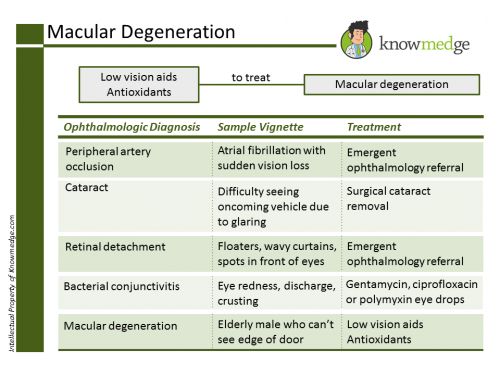
  • Painless loss of central vision
  • See drusen (i.e., yellow deposits) in the macula on ophthalmoscopic exam
  • Treatment is low-vision aids, antioxidants and sometimes laser photocoagulation to delay loss of vision in exudative macular disease
Optic Disc Pathology  

Closed-Angle Glaucoma (Acute Glaucoma)
  • Acute onset -Typical history is person sitting watching a movie in dark theater with sudden blurry vision that is usually unilateral
  • Signs and symptoms include:
    • Tender, hard eye
    • Red eye
    • Dilated pupil that is semi-responsive to light
  • Obtain stat ophthalmologic consult
  • Conduct tonometry (i.e., measure pressure in the eye) for diagnosis
  • Treat with IV acetazolamide or acetazolamide eye drops
    • Carbonic anhydrase inhibitors – decrease the production of bicarbonate
  • Can also give β blocker eye drops (i.e., timolol)
  • Consider cholinergic eye drops (i.e., pilocarpine)
    • Never give anticholinergics to patients with glaucoma
  • Definitive treatment is laser iridotomy
Open-Angle Glaucoma (Chronic Glaucoma)
  • Occurs more gradually as vision is lost
  • Painless
  • Treatment is to decrease intraocular pressure with topical eye drops (i.e., acetazolamide, timolol, or pilocarpine)
    • Never give anticholinergics
  • Definitive treatment is laser iridotomy
Lens Pathology 

Cataracts
  • Clouding of the lens
  • Patients may present with loss of visual acuity
  • Requires ophthalmologic follow-up with slit-lamp examination
  • Treatment is usually surgical if vision loss is progressive and discomforting
Presbyopia
  • Difficulty for lens to focus
  • Decrease in near-sightedness
  • Presbyacusis – loss of hearing with age (i.e., usually high frequency sounds)
  Vessel Pathology 

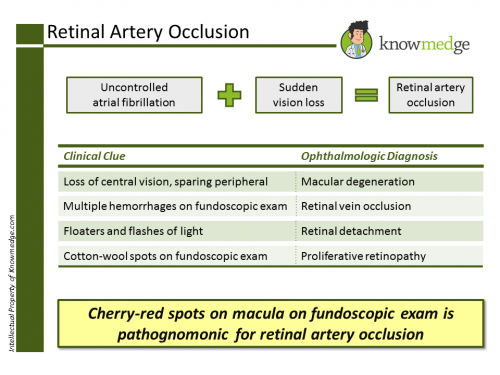
Central Retinal Artery Occlusion
Internal Medicine Retinal Artery Occlusion 

Exclusive visual from the Knowmedge QVault
  • May be from emboli
  • May be from atherosclerosis or Diabetes
  • Sudden blurry vision or loss of vision in one eye
  • Painless -May respond poorly to light, but will constrict abruptly when light shined in other eye
  • See cherry red spot on the macula and a pale fundus
  • Treat with thrombolysis if within 8 hours since symptom onset
  • Consider IV acetazolamide or timolol to decrease intraocular pressure
  • Prescribe aspirin daily
  • If suspect may be secondary to temporal arteritis, start IV prednisolone immediately and schedule temporal artery biopsy
Central Retinal Vein Occlusion
  • Visual loss is painless and occurs gradually
  • Ophthalmologic exam is critical
    • Dilated tortuous veins
    • Retinal hemorrhages
    • Cotton-wool spots
    • Macular edema
  • Treat with laser photocoagulation
    • Especially for diabetic retinopathy with neovascularization and branch retinal vein occlusion
  • Prescribe aspirin daily
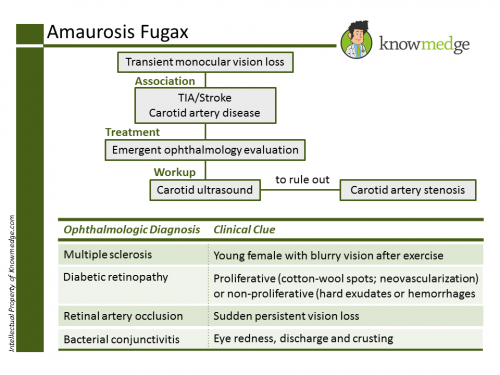
Amaurosis Fugax
Internal Medicine Amaurosis Fugax 

Exclusive visual from the Knowmedge QVault
  • Sudden, transient loss of vision
  • Usually unilateral
  • Described as a curtain coming down vertically over the visual field
  • Caused by transient ophthalmic artery (i.e., branch off internal carotid artery) occlusion
  • Ultrasound carotids to detect degree of stenosis
    • If greater than 70 % stenosis with symptoms (i.e., amaurosis fugax), carotid endarterectomy is indicated
  • May also do Stenting or balloon angioplasty
  • If carotid stenosis greater than 60 % and patient asymptomatic, carotid endarterectomy indicated
  • Prescribe aspirin daily

NeuroOphthalmology 

Lesions along Visual Processing Circuit
  • Lesion of Right Optic Nerve
    • Blindness in right eye
    • No reaction to light in right eye
    • Left eye does not constrict with light in right eye
  • Lesion at Optic Chiasm
    • Patients present with bitemporal hemianopsia
    • Seen in pituitary tumors, craniopharyngiomas, or Rathke’s cleft cyst
  • Lesion of Right Optic Tract
    • Causes a contralateral homonymous hemianopsia with loss of macular vision
  • Lesion of Right Optic Tract in Meyer’s Loop in Temporal Lobe
    • Causes a left superior quadrantonopsia (i.e., “pie in the sky”)
  • Lesion of Right Optic Tract in Parietal Loop in Parietal Lobe
    • Causes a left inferior quadrantonopsia
  • Lesion in Right Occipital Lobe
    • Causes a left homonymous hemianopsia with macular sparing  Seen in posterior cerebral artery (PCA) distribution infarctions
  Tumor/Cancer 

Retinoblastoma
  • Autosomal recessive
  • Mutation of RB1 gene(Tyrosine kinase)
  • Mutation on chromosome 13
  • Most distinctive sign is leukocoria
    • White spot present in the patient’s pupil upon light testing
    • If detected on ophthalmoscopic exam, treatment is stat ophthalmology consult
  • Treatment is enucleation
This post was originally posted on the Knowmedge Blog

Monday, May 5, 2014

What you Need to Know about Cardiac Murmurs for the Boards and Wards

Whether you’re in medical school lectures, clerkships, internal medicine residency, or studying for a board exam, it’s one of the most frustrating Internal Medicine topics to master. We’re of course talking about cardiac murmurs. Understanding them requires a consideration of cardiovascular physiology.
ABIM Exam Board Review: Cardiology Murmurs
Internal Medicine Board Review: Cardiac Murmurs
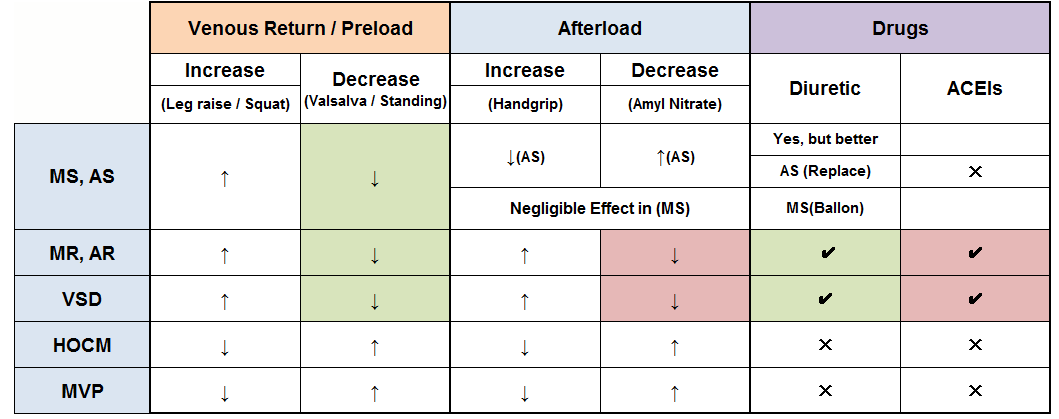
↑=↑ Murmur Intensity
↓=↓Murmur Intensity
↓ with Valsalva = ✔ Diuretics
↓ with Amyl Nitrate = ✔ ACEIs

MS= Mitral Stenosis AS= Aortic Stenosis MR= Mitral Regurgitation AR= Aortic Regurgitation VSD= Ventricular Septal defect HOCM= Hypertrophic Obstructive Cardiomyopathy MVP= Mitral Valve Prolapse

Understanding Murmurs and Maneuvers: Understanding heart auscultation and specifically some effects of various maneuvers on murmurs plays an important role in the cardiology section on any medical exam board (USMLE Step 2 CK and 3), as well as the Internal Medicine boards.

Common Murmurs:  
SystolicDiastolic
Aortic StenosisAortic Regurgitation
Mitral RegurgitationMitral Stenosis
MVP
HOCM

An important concept to keep in mind is that maneuvers affect the volume of blood entering the heart chambers.
  • Right-sided murmurs are increased with inhalation
  • Left-sided murmurs are increased with exhalation
  VENOUS RETURN / PRELOAD:

What increases venous return to the heart / Preload?
  • Squatting
  • Lifting the legs
What decreases venous return to the heart / Preload?
  • Valsalva
  • Standing up

Squatting → Squeezes blood up into the heart → ↑Blood return to the heart.

Valsalva → ↑Intrathoracic pressure → ↓ Blood return to the heart.   We can clearly observe in the table that MS, AS, MR, AR and VSD become louder with leg raising and squatting, except HOCM and MVP, which become softer with these maneuvers. On the other hand, MS, AS, MR, AR and VSD become softer with valsalva and standing, except HOCM and MVP, which become louder with such maneuvers.

AFTERLOAD:

What increases afterload?
  • Handgrip
What decreases afterload?
  • Amyl Nitrate

Handgrip → Contract arms muscle → Compresses arteries of the arm

Amyl Nitrate (Vasodilator) → Dilate peripheral arteries

As we can see in the table, handgrip softens the aortic stenosis murmur by preventing blood leaving the ventricles. In other words, if the afterload goes up, blood cannot be ejected from the left ventricles, and the aortic stenosis murmur will soften.

In Amyl nitrate, if the afterload goes down, blood can be easily ejected from the left ventricles, and finally worsening or making it louder.

An important point to mention is that handgrip and Amyl nitrate have a negligible effect on mitral stenosis since both maneuvers do not affect ventricular filling which is important in such murmurs.

Aortic and mitral regurgitation are worsen or louder by handgrip because this pushes blood backward into the heart. The same rule apply for VSD, since more blood goes from the left to the right and making it louder.But since Amyl nitrate has the opposite result of hangrip, then this improves both aortic and mitral regurgitation.

On the other hand, while handgrip improves or soften the MVP and HOCM murmurs due to a large left ventricle caused by the increased afterload, Amyl Nitrate will result in an opposite effect which appear as an increased ventricular emptying due to a decreased afterload that ultimately worsen the obstruction and makes the murmur louder.

DRUGS:

Based on the table above, we can observe that mitral and aortic regurgitation can be treated with vasodilators, like ACEi, and ARBs.

ACE inhibitors basically functions as the opposite of handgrip, by decreasing afterload which at the same time increases the forward flow of blood out of the left ventricle. In some cases when the medical therapy is not enough, then valve replacement is the best option.

On the other hand, mitral and aortic stenosis are appropriately treated with surgery. Whereas mitral stenosis is treated with balloon valvuloplasty (or valve replacement when valvuloplasty is not an option depending on certain valve characteristics), aortic stenosis is best treated with valve replacement.

Note: Even though diuretics can decrease pulmonary vascular congestion in either mitral or aortic stenosis, they are not as effective as balloon valvuloplasty or valvular replacement. Also important to mention, is that ACE inhibitors have scant effect on mitral stenosis.

An important concept that can help us to remember the uses of diuretics and ACEIs is as follows:
  • If valsalva improves the murmur, diuretics can be used.
  • If Amyl nitrate improves the murmurs, ACEIs can be used.

Hopefully, after reading this post, you feel more confident in answering questions about murmurs on your internal medicine board exam or any other medical board exam.

Internal Medicine Topic Review: Leukemia
Internal Medicine - USMLE Step 3 - Leukemia
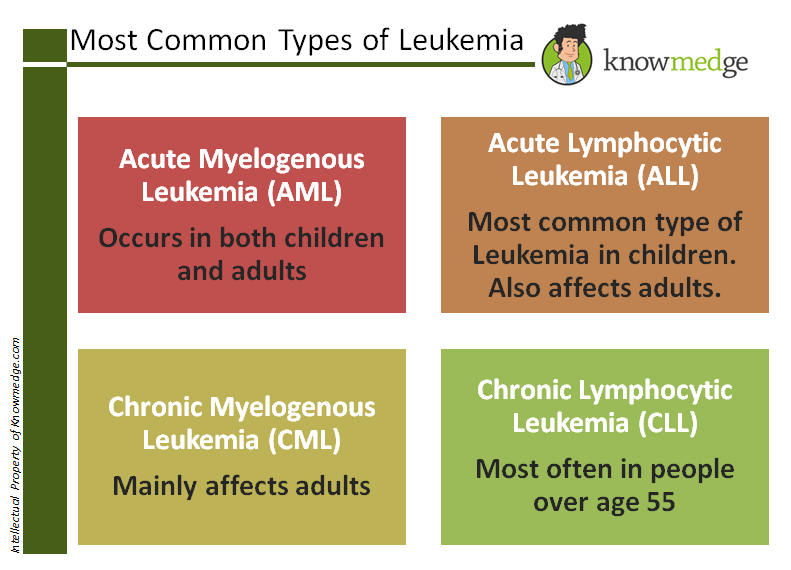
The Four common types of Leukemia

Leukemia is a commonly tested topic on the ABIM exam and on other medical exams where internal medicine is a major focus. As you heard earlier this week, we’re really excited to get to share with you some of the gems out of the Cracking the USMLE Step 3… Today, as we continue along #OncWeek, we’re reviewing leukemias.

The following excerpt is taken directly from Cracking the USMLE Step 3.

Acute Myelogenous Leukemia (AML)
  • Signs and symptoms include:
    • Shortness of breath
    • Easy bruising and bleeding
    • Infection
    • Splenomegaly
  • May see Auer rods in peripheral smear
    • Red rod shaped structures in the cytoplasm of myeloblasts
  • Definitive diagnosis requires bone marrow biopsy
    • Greater than 20 % of the bone marrow infiltrated with myeloblasts
  • Positive myeloperoxidase
    • Differentiates AML from Acute Lymphocytic Leukemia (ALL)
    • Treatment involves chemotherapy with cytarabine
    • Bone marrow transplant is best treatment overall for remission
    • Several subtypes
      • Acute Promyelocytic Leukemia (APL)
        • Translocation of chromosomes 15 and 17
        • Treat with trans-retinoic acid
Acute Lymphocytic Leukemia (ALL)
  • Good prognosis (i.e., cure rate 85%)
  • Increased incidence in:
    • Down syndrome
    • Fanconi’s anemia
    • Ataxia-telangiectasia
    • Bruton’s agammaglobulinemia
  • Signs and symptoms include:
    • Infections
    • Enlarged lymph nodes
    • Splenomegaly
    • Petechiae
  • Diagnose initially with CBC
  • Peripheral smear shows blasts
  • Definitive diagnosis made with bone marrow biopsy definitive with blasts
  • Treat with chemotherapy
  Chronic Myelogenous Leukemia (CML)
  • Signs and symptoms include:
    • Gout
    • Infections
    • Easy bruising and bleeding
    • Splenomegaly
  • Philadelphia chromosome is key in diagnosis
    • Chromosomes 9 and 22 translocation
  • CML must be distinguished from leukemoid reaction
    • Leukemoid reaction has positive leukocyte alkaline phosphatase
    • CML negative for leukocyte alkaline phosphatase
  • Can evolve into a blast crisis
    • Greater than 20 % myeloblasts in the blood or bone marrow
  • Treat with imatinib (i.e., Gleevac), a tyrosine kinase inhibitor
    Chronic Lymphocytic Leukemia (CLL)
    • Most common form of leukemia
    • May transform into Richter’s syndrome
      • Acute leukemia
    • Peripheral smear shows smudge cells
      • Cells are fragile when smeared onto glass slide
    • To definitively diagnosis, obtain bone marrow biopsy with flow cytometry to show markers CD19 and CD20 (i.e., B cell lineage markers)
    • If symptomatic, start with fludarabine
    • May also use rituxamab, an antibody against CD20 or alemtuzumab, an antibody against CD52·
      Cracking the USMLE Step 3 is a leading textbook for USMLE Step 3 board exam preparation. The book was published in May 2012 and is available for sale online and at retailers nationwide.

      The post originally appeared on the Knowmedge Blog

      USMLE Step 3 IM Topic Review: HIV

      HIV is an important topic to understand for the USMLE Step 3, ABIM, and on other medical exams where internal medicine is a major focus. The following is an excerpt out of Cracking the USMLE Step 3

      Human Immunodeficiency Virus (HIV)
      • Single stranded RNA retrovirus
      • Check CD4 count and viral load to assess disease progression and degree of immunosuppression
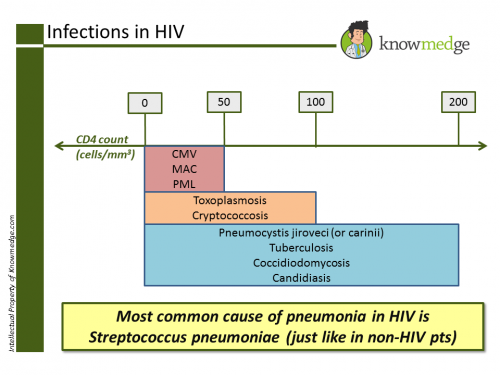
      • If CD4 count less than 200, beware of:
        • Pneumocystis carinii pneumonia (PCP)
          • Place patient on trimethoprim-sulfamethoxazole (i.e., Bactrim) for prophylaxis
        • Tuberculosis (TB)
        • Coccidiomycosis
        • Candidiasis
      • If CD4 count less than 100, beware of:
        • Toxoplasmosis
        • Cryptococcosis
      • If CD4 count less than 50, beware of:
        • Cytomegalovirus (CMV) infection
        • Mycobacterium avium intracellulare (MAC) infection
          • Cause of watery diarrhea in HIV patients
          • Diagnose by finding acid fast bacilli in stool
          • Place patient on azithromycin or clarithromycin for prophylaxis
        • Progressive multifocal leuokoencephalopathy (PML)
          • Caused by JC virus normally residing in the kidneys
          • Causes white matter destruction of the brain
          • LP shows aseptic meningitis
          • Diagnose with brain biopsy
          • Poor prognosis
      • Internal Medicine Infections in HIV
      • Other complications include:
        • Kaposi sarcoma
          • Most common cancer seen in HIV patients
          • Almost seen exclusively in homosexual men with acquired immunodeficiency syndrome (AIDS)
          • Caused by HHV-8
          • Purple maculopapular rash that is usually localized
          • Clinical diagnosis with biopsy
          • Treat with chemotherapy and radiation
        • Pneumonia
          • Most common cause of pneumonia in HIV patients is Streptococcus pneumoniae
        • AIDS dementia at end stage
      • HIV can progress to AIDS
        • Look for AIDS-defining illnesses
        • Includes all diseases noted above
      • Begin treatment for HIV/AIDS when patient’s CD4 count is 350 or less or with documentation of an AIDS-defining illness
      • Treat with at least 3 medications to prevent resistance
        • Highly active antiretroviral therapy (HAART) therapy includes nucleoside reverse transcriptase inhibitors, non-nucleoside reverse transcriptase inhibitors, and protease inhibitors
        • Compliance is extremely important to prevent resistance
      • If patient is HIV positive, physician has obligation to discuss with patient that they need to inform all their sexual partners who have been exposed of their HIV status as well as their current sexual partner
      • Member of TORCH infections
        • Transmitted transplacentally
        • Place pregnant woman who is HIV positive on zidovudine starting at 14 weeks to prevent vertical transmission
        • Place neonate on IV zidovudine after birth if concerned about exposure
        • Indication for Cesarean section (C-section) if membranes are not yet ruptured or viral load is above 1000
        • Can deliver vaginally if membranes are already ruptured and viral load is not high
        • Breastfeeding is contraindicated
      We hope this high-yield review should help you answer questions related to infections in the context of HIV on the USMLE Step 3, ABIM, and on other medical exams.

      This blog was originally posted on the Knowmedge Blog

      Thursday, April 3, 2014

      Internal Medicine Board Review Topic: JNC8

      Perhaps no topic is as difficult to categorize into the appropriate section of the ABIM Board, NBME Shelf, or USMLE Step exams as is hypertension.

      Is elevated blood pressure a topic for General Internal Medicine (we see it more than any other speciality)? Cardiology (where the patients with difficult-to-control hypertension go)? Or is it related to Nephrology (where most of the anti-hypertensive medications act)? Fortunately, agreeing on the perfect location in the syllabus is not for you to worry about. Nor do you need a deep understanding of each previous iteration of the somewhat fickle hypertension guidelines. When it comes to hypertension for the sake of the boards and the wards, all you need to do is master the latest recommendations regarding blood pressure management.

      In December 2013, the 8th edition of the Joint National Committee (JNC 8) hypertension guidelines released after multiple delays, leading some critics to dub it “JNC Late.

      Despite their tardiness, the JNC 8 guidelines serve as the gold standard for determining the goal systolic and diastolic blood pressure levels in our patients, taking into account age and comorbid conditions.
      • Patients age 60 years or older who do not have diabetes or chronic kidney disease (CKD) should be targeted to have a goal blood pressure of less than 150mmHg systolic and less than 90mmHg diastolic.
      • Patients age 18 to 59 years have a goal of less than 140mmHg systolic and less than 90mmHg diastolic.
      • Patients of any age with diabetes or CKD also have a goal of less than 140mmHg systolic and less than 90mmHg diastolic.
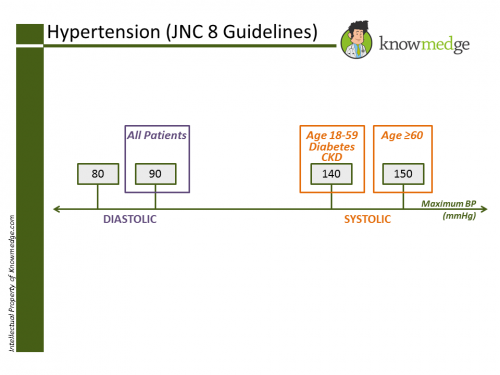
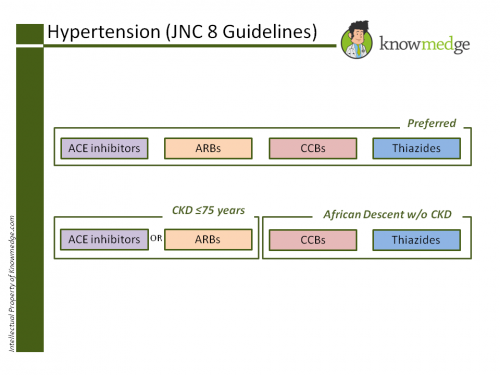
      Internal Medicine Hypertension JNC 8 Guidelines One of the best changes of the JNC8 over JNC7 for board exam purposes is the simplification of the goal diastolic blood pressure. All patients, based on age or the presence of diabetes/CKD are managed to a goal of less than 90mmHg.

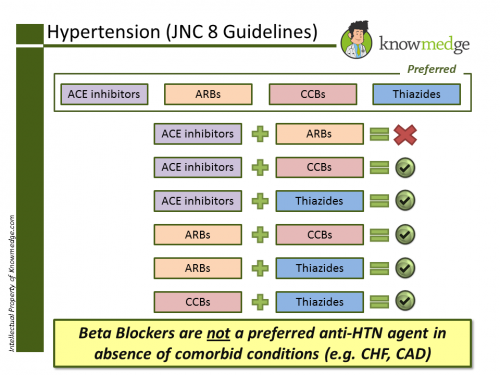
      Much of the focus of the JNC 8 is on the target blood pressure readings. However, it also provides recommendations to promote the safer use of specific anti-hypertensive agents. Preferred medications to be used as first-, second-, and third-line agents include the following four drugs:
      • Angiotensin converting enzyme (ACE) inhibitors
      • Angiotensin receptor blockers (ARBs)
      • Calcium channel blockers (CCBs)
      • Thiazide diuretics
      With the exception of concurrent ACE inhibitors and ARBs, other combinations of the 4 agents can be administered to titrate to goal blood pressure. Note that missing from the above list are beta blockers, which are no longer considered top candidate medications for hypertensive patients in the absence of comorbidities (patients with prior myocardial infarction or congestive heart failure). Internal Medicine Hypertension JNC 8 Guidelines Meds

      ACE inhibitors or ARBs are an essential part of hypertensive management in patients up to age 75 with CKD, regardless of ethnic background. Meanwhile, in patients greater than age 75 with CKD there isn’t evidence supporting renin-angiotensin system inhibitor treatment. While ACE inhibitors or ARBs can be used, CCBs and thiazide diuretics are also an option.

      Lastly, the ethnicity also plays a role in determining the preferred anti-hypertensive agent. When initiating blood pressure lowering medication in patients of African descent, ACE inhibitors should be avoided in favor of CCBs or thiazides.

      Internal Medicine Hypertension JNC 8 Guidelines CKD

      One of our Twitter followers asked when the December 2012 guidelines would appear on board exams, partly given their controversy.
      Despite an outreach attempt to the folks at ABIM, the response I got was a generic “…We advise test takers to answer all questions according to their current understanding of clinical principles and practice. If ABIM determines that any question has been compromised by new information, that question will not be counted in your overall examination score. This information appears in the instructions at the start of every ABIM examination…”

      My recommendation is that given the adoption of these guidelines by large medical organizations such as Kaiser Permanente, you should start to use the updates for both the boards and the wards. Drop a note below giving your take on the JNC 8 guidelines.